Richard CLEWS
B: 21st May 1844 D: 12th Jun 1913
Born: 21st May 1844 Birmingham, England, UK
Married: Selina DENLEY on 17th March 1867 at St Peters Church, Birmingham, Warwickshire, England. Selina was born on the 14th December 1846 in Birmingham, England, and died 18th February 1922 at the Alpha Hospital in Queensland.
Died: 12th June 1913 Creek Farm, Alpha, Queensland
The historical information for Richard Clews has been provided by Rod Kerr, the Grandson of Harry Clews who was born in Farina.
Father: Richard CLEWS
Mother: Elizabeth PRITCHARD
Children
Frederick Richard CLEWS B: 1872 in Massachusetts, USA D: 17th Sept 1951 in Brisbane, Queensland
Francis CLEWS B: 29th Sept 1877 in Adelaide, Australia D: 31st Oct 1877 in Adelaide, aged 1 month
Harry CLEWS B: 29th Dec 1882 in Farina, Australia D: 18th Jun 1961 in Rockhampton, Queensland
Frank CLEWS B: 10th Dec 1885 in Jericho, Queensland D: 12th Aug 1968 in Brisbane, Queensland
Nelle May CLEWS B: 17th Jun 1889 in Barcaldine, Queensland D: 29th Oct 1977 in Brisbane, Queensland
Siblings
Elizabeth, CLEWS
William CLEWS
Frederick CLEWS
John CLEWS
This Biography has been provided by Rod Kerr, great grandson of Richard Clews.
Richard Clews, wife Selina (Denley) and son Frederick migrated to South Australia from Birmingham on the Oaklands, leaving Plymouth on 3rd June 1877. They were full free passengers and arrived in Adelaide on 9th September 1877.
After Frances Clews died in Adelaide aged 1 month on 31st October 1877, Harry Clews was born in Farina on 29th December 1882, five years after the move to Australia. Richard and Selina had moved from Adelaide to Farina, on the edge of the desert in the far north of South Australia, probably in late 1879.
Richard and Selina bought a plot of land, number 396, in September 1879. There was also an area set aside in the town plan for a slaughter-house. The South Australian Chronicle and Weekly Mail of 6th December 1879 recorded that R. Clews, Farina, Government Gums was approved a slaughtering license.
The town of Farina originated because of a reliable waterhole on the bend of a normally dry creek, where some gum trees flourished, known as the Gums Waterhole. In July 1859, land was taken up by G. H. Davenport and W. Fowler. The site was renamed Government Gums in about 1870, when the government built a dam to support a temporary construction camp for the Overland Telegraph Line and also to provide a reliable water supply for travelling livestock. By 1876 the town land adjacent was leased by A. M. Woolridge and in March 1876, Woolridge sent William and Francis Humphries and their daughter Sarah to maintain the water holes. The town of Government Gums was declared on 21st March 1878 and renamed Farina by the Governor of South Australia.
The railway, later known as the Ghan, started in 1879 when the first 40 km of track was laid between Port Augusta and Quorn, closely following John McDouall Stuart’s north-south continental crossing which was made in 1862. When the line was extended to Farina in May 1882, Farina became an important railhead for the transportation of livestock, wool and goods from as far away as Innamincka and western Queensland. Following the establishment of railway workshops, the town population rose to about 300 by the mid 1880’s and had two pubs, a brewery, a post office, and a bakery. In 1884, the railway line was extended first to Marree and then Alice Springs, resulting in the start of the decline of Farina as a thriving township.
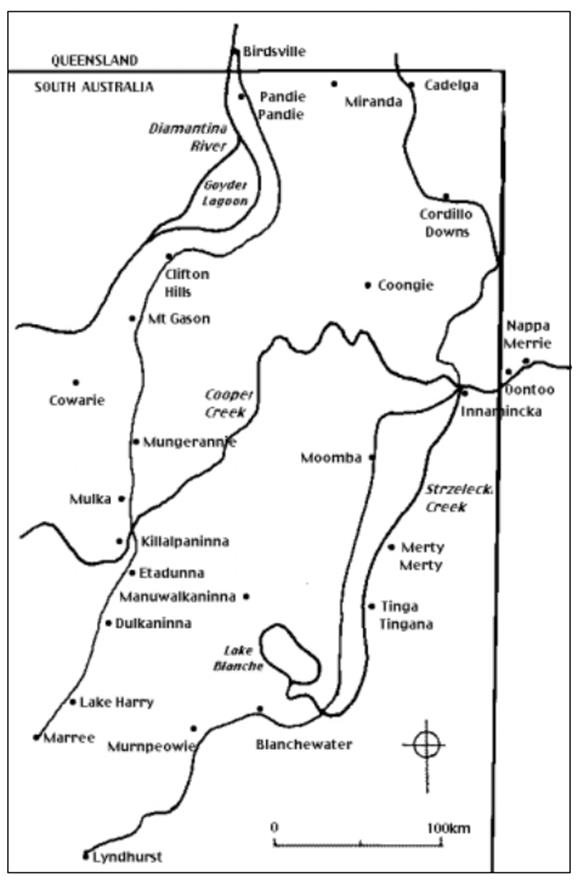
On Boxing Day 1874, the pastoralist John Conrick set out from Innamincka for Port Augusta with a stockman, driving two drays, with an Aboriginal guide leading. They moved from waterhole to waterhole down the Strzelecki Creek in a series of wary but generally peaceful encounters with large parties of Aborigines. Living on ducks nearly all the way, they arrived at Blanchewater homestead on 6th January 1875.
Conrick’s journey established that Strzelecki Creek was feasible not only for travelling stock, but for supply wagons, and that it was easy to bring cattle and supplies to Cooper Creek from South Australia. “Along this route hundreds of thousands of sheep and cattle were travelled, and scores of thousands of bales of wool sent via Farina and other northern trucking stations to Port Augusta, Adelaide and the world’s markets.”
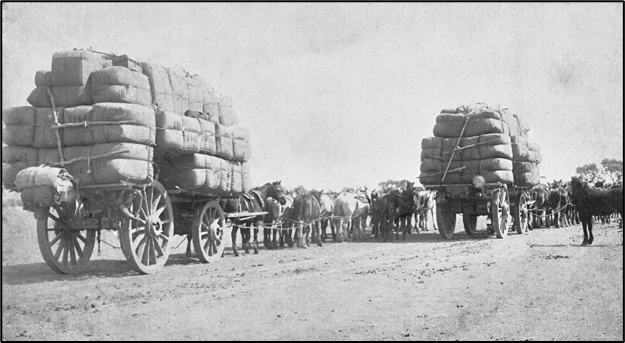
Farina was one of the jump off points for the Strzelecki and Birdsville tracks and Richard Clews is believed to have worked as a teamster up into Queensland. The Strzelecki led to Innamincka and beyond into Queensland, however, the Birdsville track was probably not used significantly in the 1880’s due to lack of reliable water. Innamincka was situated beside the Cooper Creek and was originally a customs post, taxing the movement of stock between the colonies of South Australia and Queensland.
When Harry Clews was about a year old and Fred about 10, Richard apparently didn’t return to Farina. Selina must have had an idea of his whereabouts as she left South Australia on a remarkable 3,500km journey to Pine Hill, in Central Queensland, in search of him. Pine Hill railway station opened in early November 1883 and was the end of the western line until the line was opened to Alpha in late 1884. It is probable that she was reunited with her sisters in Maryborough during the trip. While nursing Harry on the verandah of a Pine Hill hotel, and watching some teams coming up the road, she discovered that one of the teamsters was Richard.
[Editor] Although the story above end’s with Selina finding Richard at Pine Hill, some insight into Richards later life can be found from the obituary’s provided by Richard’s great-grandson Rod Kerr.
The Queenslander 21 June 1913
Passing of the pioneers.
Yesterday afternoon there passed away at Alpha (writes our Barcaldine correspondent on the 13th instant) Mr. Richard Clews, one of the pioneers on the Central railway line, at the age of about 65 years. Like many other of our settlers, Mr. Clews took up the very lucrative business of carrying, and conveyed rations and material to outback stations from the 70’s to quite a recent date, when, having made a fair competence, be entered into pastoral pursuits, securing some country in Monk’s Creek, near Alpha, and which he called Creek Farm. His three stalwart sons also were fortunate enough to obtain selections, and in addition secured a small shearing plant with which, for some few years past, neighbouring selectors’ flocks were shorn. For some years Mr. Clews suffered from bronchial affections and frequently came up to Barcaldine, where he obtained temporary relief. He was of a rather reserved disposition, but was generous, and, in bush parlance, “a good sort.” He left a widow and grown-up family.
The Northern Miner 26 June 1913
Our old identities are dwindling away slowly, but none the less surely, and another name has to be wiped off the slate. Mr. Richard Clews was well-known throughout the district, he having come on the railway line many years ago, and carried for a number of the Western pastoralists. When the line came to Barcaldine, he took up his residence here and continued his occupation for some years ere he relinquished carrying for grazing farming. While resident here he was a great sport, and owned Pageant, Mosley, Footsteps and others, nags which were frequently steered to victory by his sons and others, on our Western racecourses. Upon leaving the road Mr. Clews took up country on Monks Creek, near Alpha, which he called Creek Farm, his three stalwart sons subsequently securing country in the same district. They also had a small shearing plant, for which plenty of work was found among the numerous small selectors in the neighbourhood. A few years ago Mr. Clews contracted a bronchial complaint, and he used frequently to come to Barcaldine where he found temporary relief. Lately he failed rapidly, but no one expected his death to take place so suddenly as it did at Alpha on Thursday afternoon. Mr. Clews, who was about 65 years of age, left a wife and grown up family to mourn their loss.
The Western Champion 25 February 1922
Mrs. Selina Clews passed away in the Alpha Hospital on Saturday, Feb. 18th. Deceased had been ailing for some time. The late Mrs. Clews was 76 years of age at time of her death. The body was taken to the cemetery on Sunday from the residence of Mr. B. Hutchins, a friend of the Clews’ family. Mr. H. Cornelius officiated at the graveside according to the rites of the Church of England. A large number of friends assembled at the graveside to pay their last sad respects to one who had been held in esteem by all. A grown up family of three sons and one daughter is left to mourn their loss.
Richard’s horse teams about 1900.